
Afleveringen
-
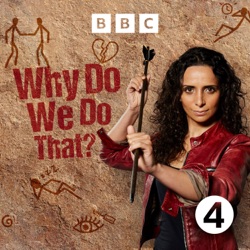
Ella Al-Shamahi explores evolutionary mysteries in More Play with Brenna Hassett.
BBC Studios AudioProducer: Olivia JaniAdditional Production: Emily BirdSeries Producer: Geraldine FitzgeraldExecutive Producer: Alexandra Feachem
-
Paleoanthropologist Ella Al-Shamahi asks why do humans play?
The Neanderthals are a species that was so close to us that we could reproduce with them, they had creativity, technology and they made art - handprints on cave walls and painted shells strung into necklaces. But it turns out the Neanderthals had shorter childhoods than us. Their children grew up quicker than their Homo sapiens counterparts.
We don’t know why Neanderthals went extinct. It is probably for a few reasons but is it possible that us having these longer childhoods, having more time to play, might have given us a creative edge. There are probably more important reasons for our survival over them but it is food for thought.
And we are still playing, anthropologist Brenna Hasset says play is part of learning how to be an adult so depending on where you grow up influences the type of games children play.
BBC Studios AudioProduced by Emily BirdAdditional production Olivia Jani and Ben HughesSeries Producer Geraldine Fitzgerald Executive Producer is Alexandra Feachem Commissioning Editor is Rhian Roberts
-
Zijn er afleveringen die ontbreken?
-
Ella Al-Shamahi explores evolutionary mysteries in More Bad Boys with Julia Stern.
BBC Studios AudioProducer: Olivia JaniAdditional Production: Emily BirdSeries Producer: Geraldine FitzgeraldExecutive Producer: Alexandra Feachem
-
Paleoanthropologist Ella Al-Shamahi looks at the evidence for what people want in a partner and how it changes as they get older. Psychologist Julia Stern from the University of Bremen shares the results of a study which recruited people from a singles night in a Berlin club and followed them for 13 years. Novelist Adele Parks explains why writing about bad boys is so much fun, and on the Bridget Jones scale of bad boys think more Hugh Grant and less Colin Firth.
-
Ella Al-Shamahi explores evolutionary mysteries in More Dancing with Bronwyn Tarr.
BBC Studios AudioProducer: Olivia JaniAdditional Production: Emily BirdSeries Producer: Geraldine FitzgeraldExecutive Producer: Alexandra Feachem
-
Dance seems like such a natural thing, a good beat comes on and you can’t help it, you might find yourself bobbing, even the rhythmically impaired might find themselves tapping their fingers along to the music and it starts early - one study has shown that babies as young as 5 months engage in rhythmic movements.Every culture on earth dances and yet look around at the rest of the animal kingdom… besides birds, can we say that other animals dance? Paleoanthropologist Ella Al-Shamahi asks why do we dance?
-
Ella Al-Shamahi explores evolutionary mysteries in More Pubs with Robin Dunbar.
BBC Studios AudioProducer: Olivia JaniAdditional Production: Emily BirdSeries Producer: Geraldine FitzgeraldExecutive Producer: Alexandra Feachem
-
Humans have evolved to drink alcohol, or at least to be able to metabolise it. And we share this ability with our closest living relatives, the chimpanzees and gorillas, who are also able to convert alcohol into sugar. It gave our ancestors an advantage because we could eat rotting fruit from the forest floor and convert the alcohol into sugars, providing a source of nutrients that not all species could digest. This is also known as the drunken monkey hypothesis. But paleoanthropologist Ella Al-Shamahi asks Professor Robin Dunbar if alcohol is why we go to the pub today.
-
Ella Al-Shamahi explores evolutionary mysteries in More Nature with Gregory Bratman.
BBC Studios AudioProducer: Olivia JaniAdditional Production: Emily BirdSeries Producer: Geraldine FitzgeraldExecutive Producer: Alexandra Feachem
-
Nature is charismatic, a good view can take our breath away and a walk in the woods can help de-stress our frazzled minds. But have we always been this way? Because after all, our early ancestors didn’t have cities to escape from. Is an affinity with the natural world around us, something we inherited? Ella Al-Shamahi asks psychologist Dr Gregory Bratman and Robin Muir Head of Maggie’s Cancer Care Centre Manchester what are the benefits of spending time in green spaces.
-
Ella Al-Shamahi explores evolutionary mysteries in More Blushing with Laith Al-Shawaf.
BBC Studios AudioProducer: Olivia JaniAdditional Production: Emily BirdSeries Producer: Geraldine FitzgeraldExecutive Producer: Alexandra Feachem
-
Paleoanthropologist Ella Al-Shamahi asks why we blush. Even Darwin was intrigued by blushing. He called it “the most peculiar and most human of all expression” but didn’t think it had a function. Dr Laith Al-Shawaf from the University of Colorado makes students do embarrassing things to understand why we blush and how blushing can make people like you more when you make a mistake.
-
Ella Al-Shamahi explores evolutionary mysteries in More Lies with Roman Stengelin.
BBC Studios AudioProducer: Olivia JaniAdditional Production: Emily BirdSeries Producer: Geraldine FitzgeraldExecutive Producer: Alexandra Feachem
-
Ella Al-Shamahi asks why do we lie?You might think that deception is a uniquely human characteristic, but does camouflage or mimicry in nature, where animals pretend to be another animal or the actual environment like the insects leaf-mimic katydids that walk around looking like a leaf. Does that count as lying? Or is it just us humans with our highly complex language that have the ability to tell a fib. Ella talks to Dr Roman Stengelin of the Max Planck Institute for Evolutionary Anthropology, who investigates children from very different cultures to discover when and how they develop this very human ability and professional poker player Liv Boeree to discover the art of bluffing.
BBC Studios Produced by Emily BirdAdditional production Olivia Jani and Ben HughesSeries Producer Geraldine Fitzgerald Executive Producer Alexandra Feachem Commissioning Editor Rhian Roberts
-
BONUS: Ella Al-Shamahi explores evolutionary mysteries in More Laughs with Sophie Scott.
BBC Studios AudioProducer: Olivia JaniAdditional Production: Emily BirdSeries Producer: Geraldine FitzgeraldExecutive Producer: Alexandra Feachem
-
Ella Al-Shamahi asks why do we laugh?
Some people might not have a sense of humour, you might even know someone who never laughs… but there isn’t a culture out there, say a tribe, where people just never laugh. It does appear to be universal but how universal and how primal?
Many mammals and the great apes ( chimpanzees, gorillas and bononbos) laugh. Orangutans diverged from the other great apes including us about 12 million years ago and because we all laugh that suggests our shared common ancestor laughed. So what is the purpose of laughing? Ella talks to Professor Sophie Scott from University College London and stand-up comic Ria Lina.
-
Ella Al-Shamahi asks why do we love dogs? Dogs evolved from wolves but why did they choose us humans to be their best friends?
They say dogs are a man’s best friend but all dogs, even chihuahuas are descended from wolves, the grey wolf, a majestic, fierce and incredibly dangerous species. How did this happen but more importantly, why did we start trusting wolves? And when did wolves turn into dogs?
Dogs have been a part of our story for a long time. They are depicted in cave and rock art and dogs are a part of our story because of how useful they are. From the mundane everyday hunting and guarding to the epic stories of life saving dogs . But how did we get here? Oxford Professor Greger Lawson studies ancient dog DNA and thinks the evolution from wolves into dogs began when we both realised we could help each other.
-
BONUS: Ella Al-Shamahi explores evolutionary mysteries in More Dogs with Greger Larson.
BBC Studios AudioProducer: Olivia JaniAdditional Production: Emily BirdSeries Producer: Geraldine FitzgeraldExecutive Producer: Alexandra Feachem
-
Ella Al-Shamahi explores evolutionary mysteries in More Grandmothers with Emily Emmott.
BBC Studios AudioProducer: Olivia JaniAdditional Production: Emily BirdSeries Producer: Geraldine FitzgeraldExecutive Producer: Alexandra Feachem
-
Grandmothers are a bit of a mystery, biologically speaking. If the biological purpose of life is to survive and have children, why are they so important even once they've stopped being able to reproduce?
Of course, as we all know, grandma's are the rock of most families, and it turns out, biologically also incredibly useful. Grandmothers are a logical necessity, your mother and father also had mothers so that equals two grandmas for you.
But the evolutionary role they play in many of our lives has been less easily explained until now. Why are they so helpful? Why do they stop having children of their own? Why do we have grandmothers?!
Ella speaks to anthropologist Dr Emily Emmott, and midwife, educator and grandmother Sheena Byrom OBE
BBC Studios Audio ProductionProducer Emily BirdAdditional production Olivia Jani Series Producer Geraldine Fitzgerald Executive Producer Alexandra Feachem
- Laat meer zien
